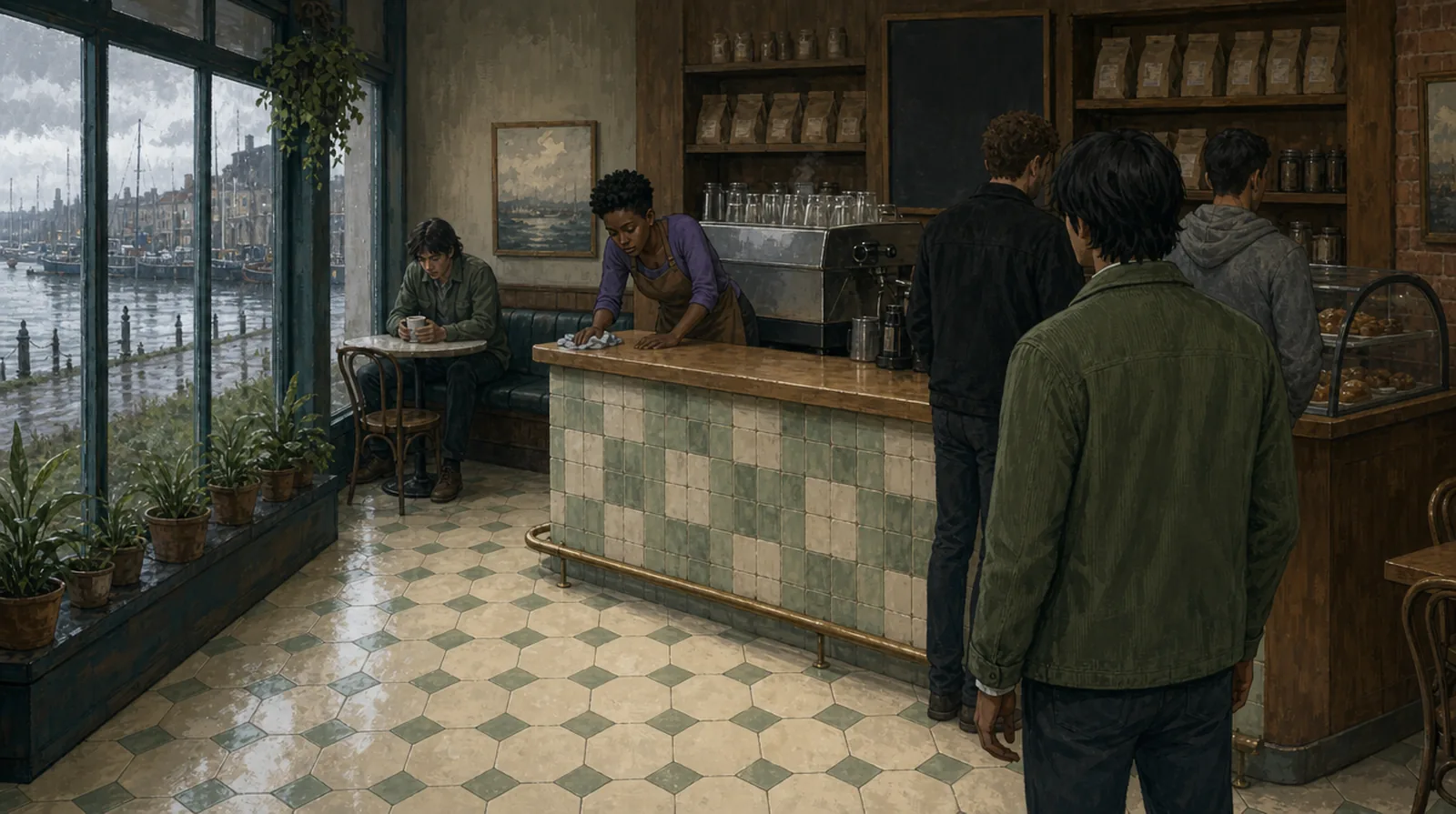
A body shows you the door. It does not show you why.
How reading body language works in TELL, and what the game refuses to claim.
The other channel
Most of it is not in the words.
Most of what passes between two people in a room is not in the words, and you already know this. You have walked out of a conversation where everything said was fine, and known, somewhere underneath language, that it was not fine. Nobody decided that. It arrived.
Sam Vale does not get it. He is a claims adjuster who writes exclusion clauses for a living and wins arguments with lawyers over the phone, and he receives language at full fidelity and nothing else. A perfect listener who hears nothing.
He learned it at home. His mother told gentle lies through his childhood, the kind that hold a family together, and believing them was how a child loved her. In that house the words were the kindness and the body was the weather nobody mentioned. Doubting what a person says out loud still feels to him like disloyalty.
What a cue is
A cue is a thing, not a meaning.
A cue is a marked part of a painting. A pair of feet under a tablecloth. The heel of a hand pressed flat into a breastbone. A glass moved from one side of the table to the middle, which is a longer journey than it sounds. None of them arrives with a translation.
That is the rule everything else hangs from. The man who lends Sam the ability states it once, early, in a bar, and never softens it afterwards: a body shows you the door, and it does not show you whether the person is leaving you or leaving a burning building.
“Rule Three is not pedantry, Sam Vale. Rule Three is the safety on the weapon.”
Mr. Aster, chapter two
Everything the game shows you is true. Nothing it shows you is an explanation. The gap between those two sentences is where the story lives.
Baseline
Nothing means anything on its own.
Before any of it is available to you, you have to hold on a person for ten unbroken seconds and let their resting state burn in. That is the first faculty, and the game calls it the still portrait. Until somebody has been sat for, they show you nothing at all. A gesture only says something measured against that particular person’s ordinary page. A man who touches his collar every ninety seconds of his life is not confessing when he touches his collar. He is being himself.
It is also why hands are withheld for seven chapters and the face for seventeen. Those are the first two places a beginner looks and the two places a person has practised most. The face is a diplomat, as the fifth chapter puts it. The feet never joined the service.
Testimony
What you would testify to.
There is a detective in this story, financial crimes, who spends a whole act refusing to let an observation turn into a verdict. She asks Sam what a touched collar is worth as testimony. Not to him. To twelve strangers and a judge. Then she answers it herself, because he is too slow: nothing, it is worth nothing, next.
So every time the game asks what you think somebody is showing, the menu carries a line that says the evidence is insufficient. The game does not treat that as the coward’s option. Those calls are counted, they are quoted back at you, and the ending is partly built out of how honestly you made them. A story that punished you for saying you do not know would be teaching the opposite of the thing it is about.
“Certain. Probable. Possible. Insufficient. There is a box for each of them and there is no fifth box and there is nothing to write in the margin.”
Detective Iyer, chapter twenty-three
The same honesty is written into the cues themselves. Three hundred and seventy-eight of them are named in the game, three hundred and sixty-five carry a reliability out of five, and every one of those carries the reasons it is wrong printed underneath it. Twenty of them are set out on one page, and the cues everybody has heard of are the ones that score low.
Twenty cues, and what the famous ones scoreAttention
Looking is a choice, and it costs.
Attention in the game is a small pool you spend. A closer look at one thing is a thing you did not look at somewhere else in the room, which is true and unhelpful, exactly like attention.
At home nothing is switched on for you and nothing asks you to look. Sam’s best friend is an emergency nurse who has been carrying something for most of the book. Her tell is the heel of her right hand pressed into her breastbone, she has no idea she does it, and she does it in her own kitchen, where the game never once marks it. You will only catch it if you decide to look at somebody you love the way you look at a witness. It is meant to feel rude.

What this is not
There is no dictionary at the back.
TELL will not make you better at reading people and does not claim that it will. There is no universal gesture that means lying, crossed arms are usually just cold, and a book that hands you a table of gestures and their meanings is selling you a horoscope with diagrams.
It is about the way a reading fails instead, which is more interesting and much closer to home: how quickly a confident reader becomes a wrong one, and how good it feels on the way past the exit. The clearest read in the first act lands on a young actuary who is guilty of nothing except being frightened in a room, and Sam’s confidence destroys him anyway. He had never been more sure of anything.
The terms
The ability is lent, never given.
The lender takes payment in kind. Twelve of the faculties are paid for, one of Sam’s own tells each, on a fixed schedule: the nervous laugh, the blush, the startle, the cuff-worry, the lean, the listening nod, the hesitation, the yield-step, the unconscious mirror, the brow-flash, the catch in the throat, and the full palms-up shrug he does when his words run out. There is no paper, because neither party is going to dispute the terms. The signature is a swallow.
By the end he can read a room the way you read a page, and there is nothing left on the outside of him for anyone else to read. The lender has been collecting legibility for sixty years and has never found anyone as legible as Sam. What he wants it for is one hour of being knowable by somebody, the way the rest of us are knowable without trying.
“One hour of being known. That is the whole enterprise.”
Mr. Aster, chapter twenty-one
Where to start
Start with the dinner.
The dinner at the corner table is the second scene of chapter one. It is the part of the story before any of this is possible, which is the only place it could start.
Play chapter oneThe dinner, read twice
Twenty-eight chapters are finished. The first one is open.
The quotations on this page are the game’s own lines.