TELL
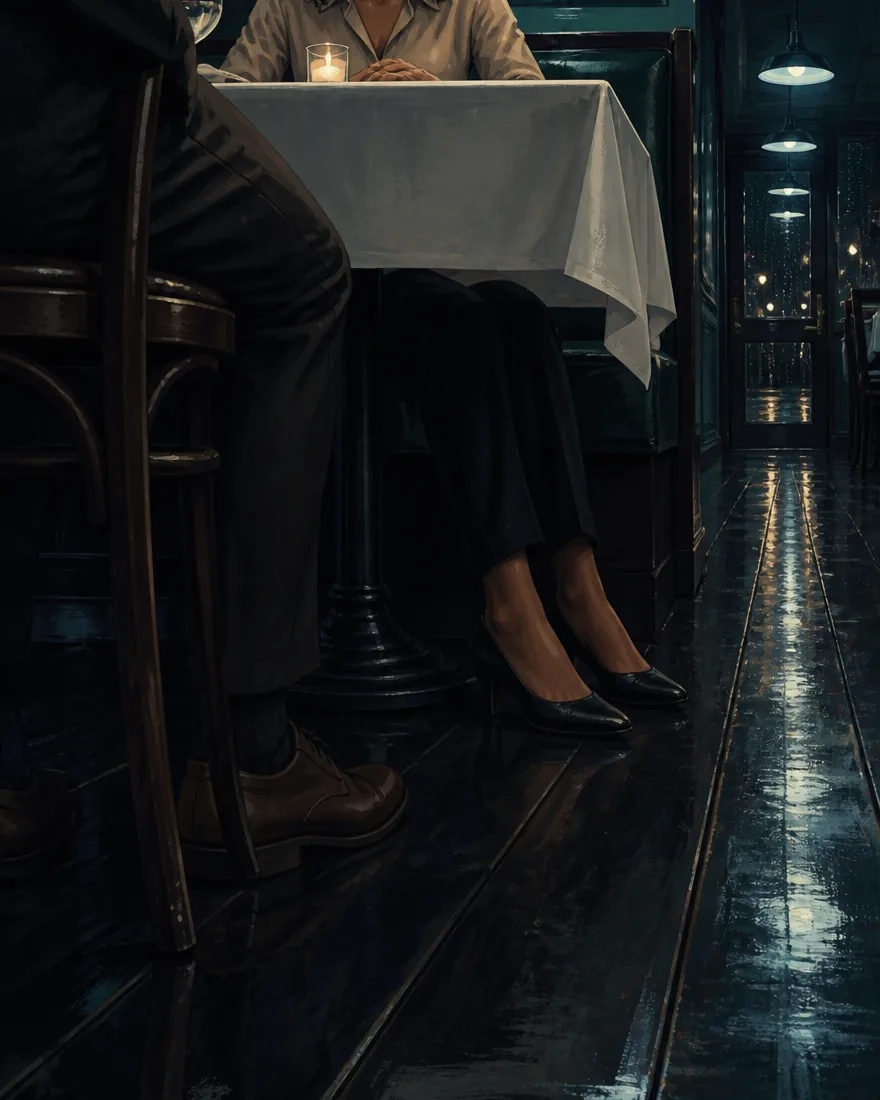
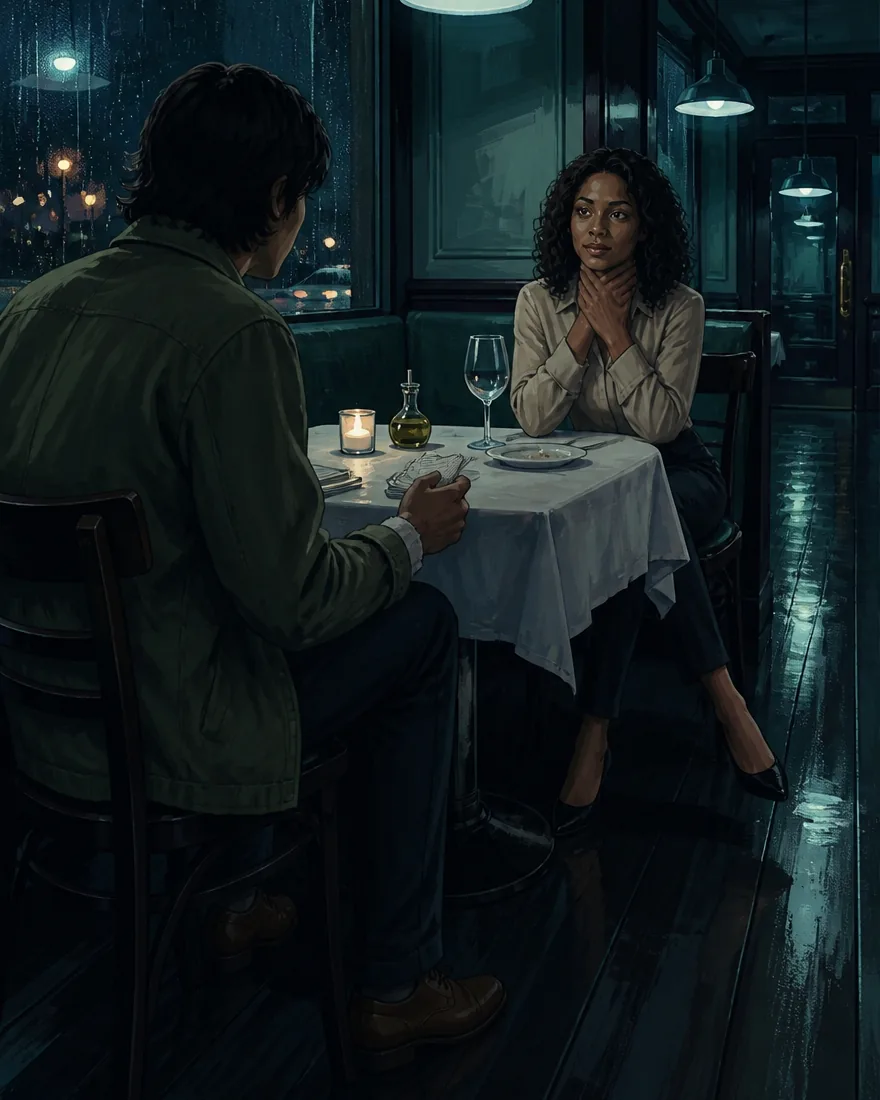
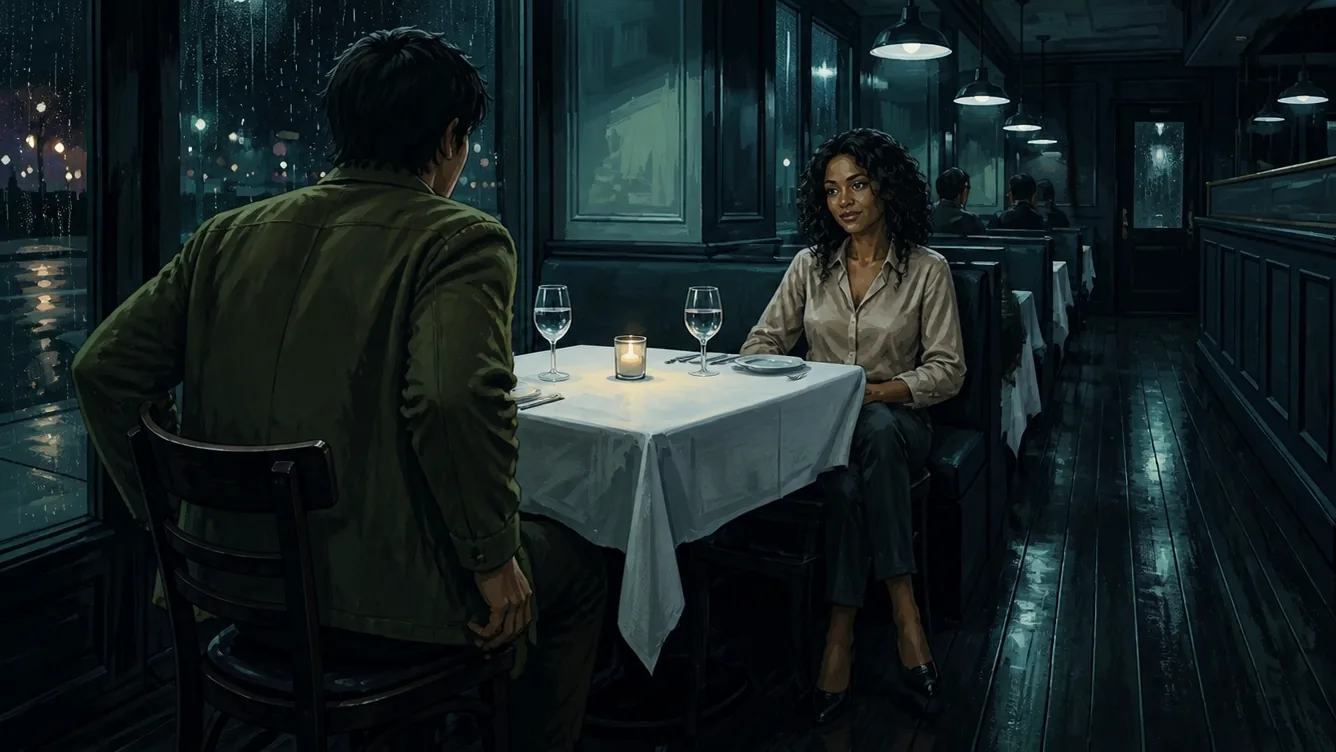
A restaurant at night, rain running down the window. A man in a jacket sits with his back to us; across the white cloth a woman sits with her knees angled toward the aisle.

Her feet left an hour before she did.

TELL is a noir in four acts about a man who is perfect with words and cannot read a room.

The lensEverything outside it is turned down. Inside it is the part of the body that gave something away.

ReliabilityOut of five, with the reasons the cue is wrong printed under it. Two or under is marked as thin evidence.

The three marksdiscomfortcomfortneutralNever a colour, always a shape and a word.

The postureComfort here is not kindness, and nothing on this page is a verdict.

The same hour, twice

One dinner, read twice.

Sam Vale spent this evening listening, and every word he heard was kind. Here is the same hour read off the body instead.

Heardthe words, and the silences between them

Readthe body, one region at a time

01 of seven

Heard

JordanYou're early. You're always early. I don't know why I said that like it's news.

SamI brought remarks. I'm declaring that now so you can brace. There are cards.

JordanI know there are cards, Sam.

Read

A restaurant at night, rain running down the window. A man in a jacket sits with his back to us; across the white cloth a woman sits with her knees angled toward the aisle.

You saw it. Sam did not.There it is. Sam did not see it either.

HIP-003

Pelvic orientation

hips/discomfort/4 of 5

Seated orientation: hips and knees set thirty degrees off the table's axis — off Sam's axis — toward the door. It has been like this since before Sam sat down.

Reads wrong when

  • Furniture and crowd geometry can force an angle
  • Some people square themselves to whoever is loudest, not whoever they favor

02 of seven

Heard

Sam is talking. The note calls these the kindest sentences.

Read

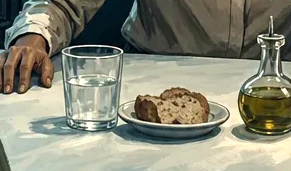
The table seen from his side. A glass, a bread plate, an oil bottle and a candle stand in a line across the middle of the cloth, with the woman behind them.

ARM-017

Object barrier

arms/discomfort/2 of 5thin evidence

Glass, plate, oil dish — migrated one by one to mid-table, a low wall of household objects assembled between her sternum and Sam's voice. Built during the kindest sentences.

Reads wrong when

  • Crowds, theft-wary travel, and heavy bags all justify chest carrying
  • Habit carries over: many people hug folders everywhere, at ease or not

03 of seven

Heard

Jordan has stopped talking.

Read

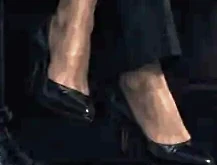
The floor under the table. His shoe by the chair leg, her two heels together on the wet boards, pointed away down the room.

FEET-002

Foot pointing away

feet/discomfort/4 of 5

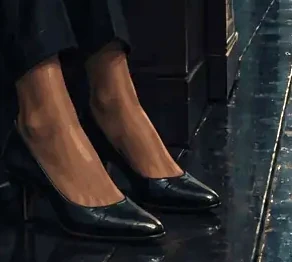
Below the tablecloth hem: both feet aimed square at the door, and they have not once aimed anywhere else. The face is at the table. The feet left an hour ago.

Reads wrong when

  • A television, buffet, or arriving friend in that direction can draw a foot for innocent reasons
  • Tight standing groups force odd angles on everyone

04 of seven

Heard

SamFour years ago at the lake you said the fog was just the lake thinking it over. I wrote it down that night. I want the next year to have a hundred of those. That's the toast. That was the good part.

Read

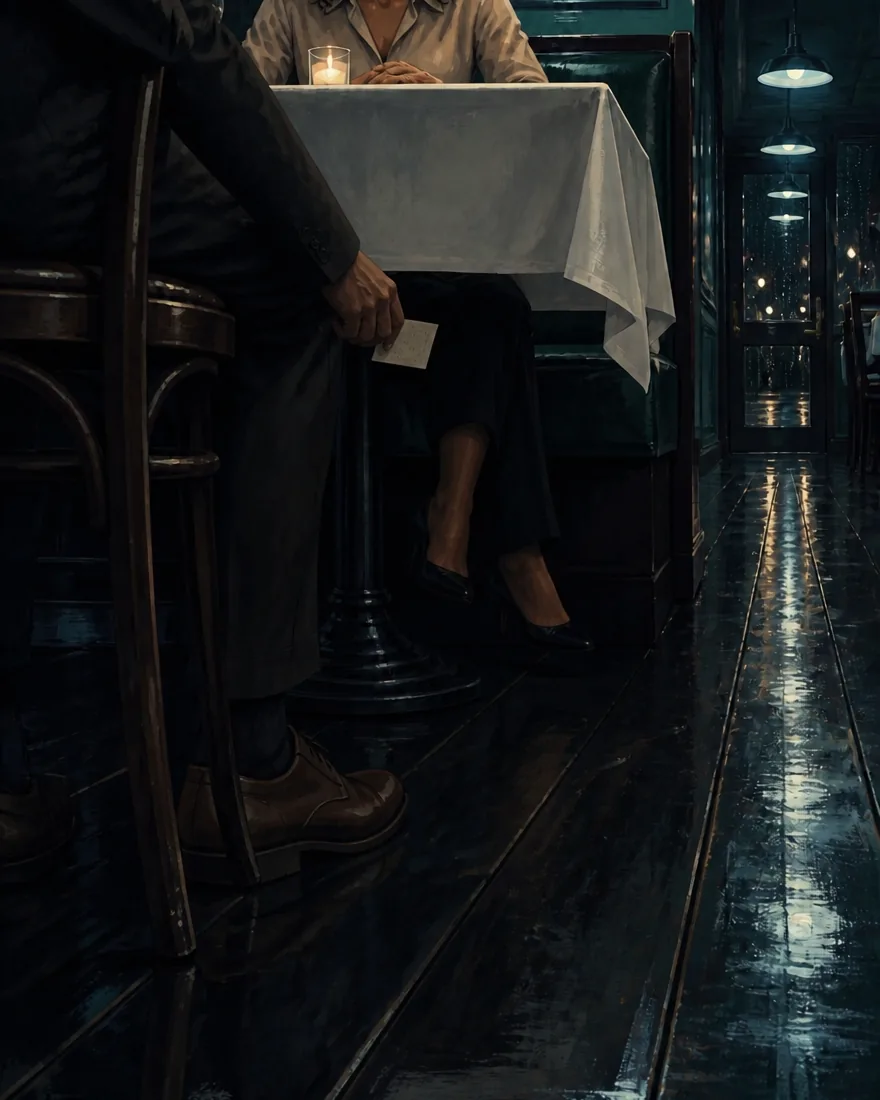
The lower half of the table. His hand holds a card at his knee; under the hem of the cloth her ankles are crossed and drawn back beneath her chair.

FEET-005

Ankle locking

feet/discomfort/3 of 5

Ankles cross and lock, tucked back under the chair — on the word ‘year.’ The sentence about the future is the one the body braced against.

Reads wrong when

  • Many people, especially those taught formal posture, cross their ankles as neutral etiquette
  • Long sits produce ankle crosses purely for comfort rotation

05 of seven

Heard

SamJordan. Next year we could—

Read

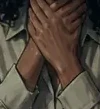
The woman across the table with both hands brought up flat against the front of her throat.

NECK-003

Throat covering

neck/discomfort/4 of 5

A two-hand dive to the throat on the words ‘next year.’ The loudest thing at the table, and the table is talking.

Reads wrong when

  • A sore throat, clothing, or a pendant can draw a hand to the front of the neck.
  • Contact during questioning does not establish distress or a lie.

06 of seven

Heard

JordanI'm leaving. I signed a lease in March. It starts the first of October. At the lake in June I said I didn't want us to keep living like this. You asked what we should change, and I said I was tired. I needed to answer you. I kept hoping you'd understand without making me say it.

Read

The woman sitting back from the table, hands in her lap and her shoulders down, looking at the man across from her.

MOUTH-019

Long exhale

mouth/comfort/4 of 5

One long slow exhale, whole body settling around it — weather clearing. Relief, arriving precisely on the other side of the sentence that ended it. Comfort is not kindness. It is only comfort.

Reads wrong when

  • Exertion and deliberate breath regulation can produce a long exhale.
  • The exhale does not prove emotional tension existed or identify its cause.

07 of seven

Heard

JordanYou'd have believed anything I said. That's why I stopped saying things.

Read

A wet street at night. The man stands under the shopfronts while the woman walks away from him down the pavement.

LEG-014

Walking pace change

legs/neutral/3 of 5

The stride that does not break. A walk changes gears when the mind does; hers doesn't, because it changed months ago. The newest thing about tonight was the audio.

Reads wrong when

  • Phones, remembered errands, and uneven pavement all interrupt stride innocently
  • Only meaningful measured against the walker's own rhythm seconds earlier

He heard a difficult decision, arrived at gently, by somebody who was sorry. Seven things said it first, six of them at that table and the last one on the walk home. He was not equipped to see one of them.

This is one evening as it runs. Sam chose to tell the story about the lake, and that choice is why the ankles are in it. Say something else at that table and the table gives up something else.

The honest part

A cue is not a verdict.

Three hundred and seventy-eight cues are named in TELL. Three hundred and sixty-five of them carry a reliability score out of five, and the scores are not flattering: twenty-one reach five, and eighty-six sit at two or below. Every one of those three hundred and sixty-five carries the reasons it is wrong. Twenty of them are set out on one page here, the famous ones among them, and the famous ones are the ones that score low.

FEET-002

4 of 5

Foot pointing away

feet/discomfort

During a face-to-face exchange, one foot — often followed by the second — rotates away from the conversation partner and settles aimed at a doorway, aisle, or open space. The upper body may remain fully turned toward the other person, producing a visible twist between hips and feet. The angle persists rather than correcting itself.

Reads wrong when

  • A television, buffet, or arriving friend in that direction can draw a foot for innocent reasons
  • Tight standing groups force odd angles on everyone

Only two cues in the feet score higher than that, and this one still has two ways to mean nothing at all.

The same reply returns on different dates. What would you put beside the evidence?

Three of those are readings. The fourth is the one where you say you do not have enough yet. Every read menu in the game carries it. In nearly all of them it sits at the bottom, and here it is at the top because the game moved it. It is also the one the game counts.

Twenty cues, and what the famous ones score
The terms

He pays for it in instalments.

The other channel is not a gift. It is lent one faculty at a time, on terms, by a man in a bar at closing time, and the payment is taken in kind. What Sam gives up is what his own body does.

  1. The nervous laugh
  2. The blush
  3. The startle
  4. The cuff-worry
  5. The lean
  6. The listening nod
  7. The hesitation
  8. The yield-step
  9. The unconscious mirror
  10. The brow-flash
  11. The catch in the throat
  12. The shrug

Payment is silent. He finds out chapters later, and somebody else always notices first. His mother hears it in his phone voice. A friend tests the startle and does not like what she finds.

Three things are held back, and he knows exactly what they are. The real smile. The tears. The hand that reaches out when he is moved.

Twenty-eight chapters later he can read anybody in a room. Nobody in the room can read him.

Four acts

  1. Act OneThe Open Book
  2. Act TwoClusters
  3. Act ThreeThe Mask
  4. Act FourThe Payment

Seven chapters each.

The chapters, and their epigraphs

Start at the first dinner.

Play chapter one

Twenty-eight chapters are finished. The first one is open.